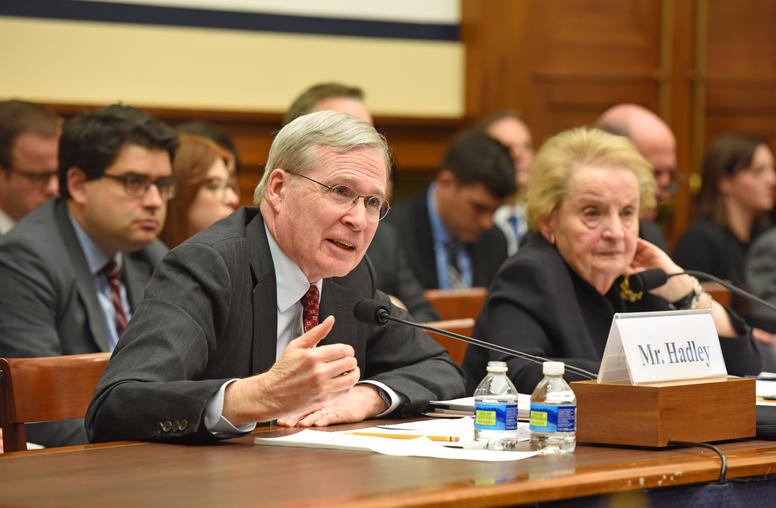
Stephen J. Hadley

Senior Adviser for International Affairs

Stephen Hadley completed four years as the assistant to the president for National Security Affairs on January 20, 2009. In that capacity he was the principal White House foreign policy adviser to then President George W. Bush, directed the National Security Council staff, and ran the interagency national security policy development and execution process.

From January 20, 2001, to January 20, 2005, Steve was the assistant to the president and deputy national security adviser, serving under then National Security Adviser Condoleezza Rice. In addition to covering the full range of national security issues, Steve had special responsibilities in several specific areas including U.S. relations with Russia, the Israeli disengagement from Gaza, developing a strategic relationship with India and ballistic missile defense.
 
From 1993 to 2001, Steve was both a partner in the Washington D.C. law firm of Shea and Gardner (now part of Goodwin Proctor) and a principal in The Scowcroft Group (a strategic consulting firm headed by former National Security Adviser Brent Scowcroft). In his law practice, Steve was administrative partner of the firm. He represented a range of corporate clients in transactional matters and in certain of the international aspects of their business – including export controls, foreign investment in U.S. national security companies, and the national security responsibilities of U.S. information technology companies. In his consulting practice, Steve represented U.S. corporate clients seeking to invest and do business overseas.
 
From 1989 to 1993, Steve served as the assistant secretary of defense for international security policy under then Secretary of Defense Dick Cheney. Steve represented the Defense Department on arms control matters, including negotiations with the Soviet Union and then Russia, on matters involving NATO and Western Europe, on ballistic missile defense, and on export and technology control matters.
 
Prior to this position, Steve alternated between government service and law practice with Shea & Gardner. He was counsel to the Tower Commission in 1987, as it investigated U.S. arms sales to Iran, and served on the National Security Council under President Ford from 1974 to 1977.
 
During his professional career, Steve has served on a number of corporate and advisory boards, including: the National Security Advisory Panel to the Director of Central Intelligence, the Department of Defense Policy Board, the Board of Directors of the U.S. Institute of Peace, as a trustee of the Carnegie Endowment for International Peace, and as a trustee of ANSER (Analytical Services, Inc.), a public service research corporation.
 
Steve graduated magna cum laude and Phi Beta Kappa from Cornell University in Ithaca, New York, in 1969. In 1972, he received his J.D. degree from Yale Law School in New Haven, Connecticut, where he was Note and Comment Editor of the Yale Law Journal.


Publications & Tools

USIP's Stephen Hadley
January 2012

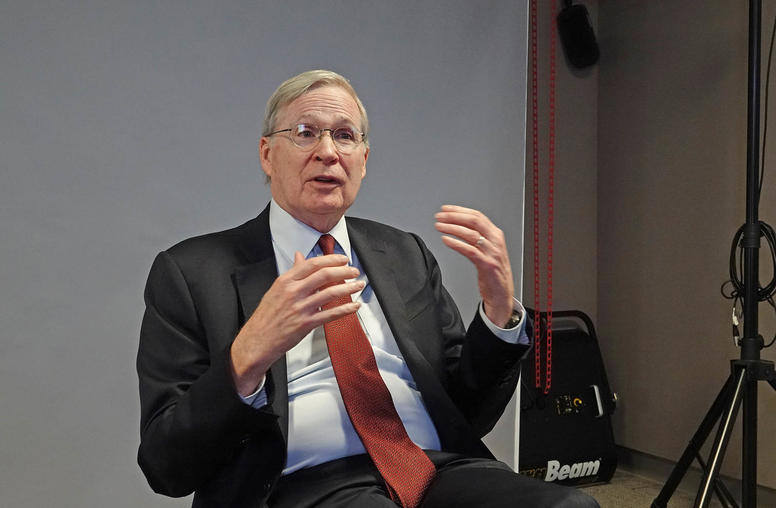
USIP's Steven Heydemann moderates a discussion about the Arab Awakening with the Institute's Stephen Hadley and the Carnegie Endowment for International Peace's Marwan Muasher.

December 2011 | News Feature by Thomas Omestad

The Obama administration’s reaffirmation of American engagement in the Asia-Pacific region for strategic and economic reasons is welcome, but describing it as a “pivot” toward the region in the wake of U.S.-led wars in Iraq and Afghanistan neglects the continuity through decades of U.S. involvement in the region, three senior foreign policy figures from the United States, Japan and South Korea said at a forum sponsored by the United States Institute of Peace (USIP) on December 15.

(NYT PHOTO)
November 2011

Former U.S. national security adviser Stephen Hadley and other top USIP staff briefed Hill members about a trip they took to Afghanistan and Pakistan this fall.

March 2011

USIP experts respond to President Obama's speech on U.S. military intervention in Libya.

Countries: Africa, Libya
February 2011 | News Feature by Tara Sonenshine

The U.S. Institute of Peace continues to follow the developments in Egypt and the Middle East.  Read about USIP's work on Christian-Muslim relations in the Middle East, work on national security issues, democratization, and more.

February 2011

Egyptian President Hosni Mubarak has resigned on Feb. 11 after weeks of peaceful protests. USIP takes a comprehensive look at the situation and its implications.

August 2010 | Congressional Testimony by William J. Perry and Stephen J. Hadley

William J. Perry and Stephen J. Hadley testified on August 3, 2010 on the "Quadrennial Defense Review Independent Panel" before the Senate Armed Services Committee.

Stephen J. Hadley
June 2010 | Congressional Testimony by Stephen J. Hadley

Stephen J. Hadley, senior adviser for international affairs, testified before the Senate Committee on Foreign Relations on the new START Treaty on June 10, 2010.

April 2010 | Congressional Testimony by William J. Perry and Stephen J. Hadley

On April 15, 2010, William J. Perry and Stephen J. Hadley testified before the House Armed Services Committee on the "Quadrennial Defense Review (QDR) Independent Panel" which is facilitated by the United States Institute of Peace (USIP). The QDR Independent Panel, which includes 12 appointees of Secretary of Defense Robert Gates and eight appointees of Congress, has been asked to submit a written assessment of the QDR by July 15, 2010.

Events

(NYT PHOTO)
January 18, 2012

In May, President Obama defined the Arab Spring as a “historic opportunity” to redefine and strengthen America’s relationships in the Middle East, demonstrating that “America values the dignity of the street vendor . . . more than the raw power of the dictator.” One year after the “Jasmine Revolution” in Tunisia, has the promise of the Arab Awakening been realized? Please join former national security adviser Stephen Hadley and former Jordanian foreign minister Marwan Muasher on Wednesday, January 18, as they lead an analysis and discussion of what the Arab Awakening means for 2012.

December 15, 2011

On December 15th, USIP hosted a panel of current and former officials from the U.S., Japan and South Korea that examined the post-2012 political, economic and security landscape in Northeast Asia following leadership changes – both democratically facilitated and planned.  Against this background, the panel assessed challenges and opportunities for the U.S., Japan and South Korea.