Jennings Randolph Peace Scholar Dissertation Program

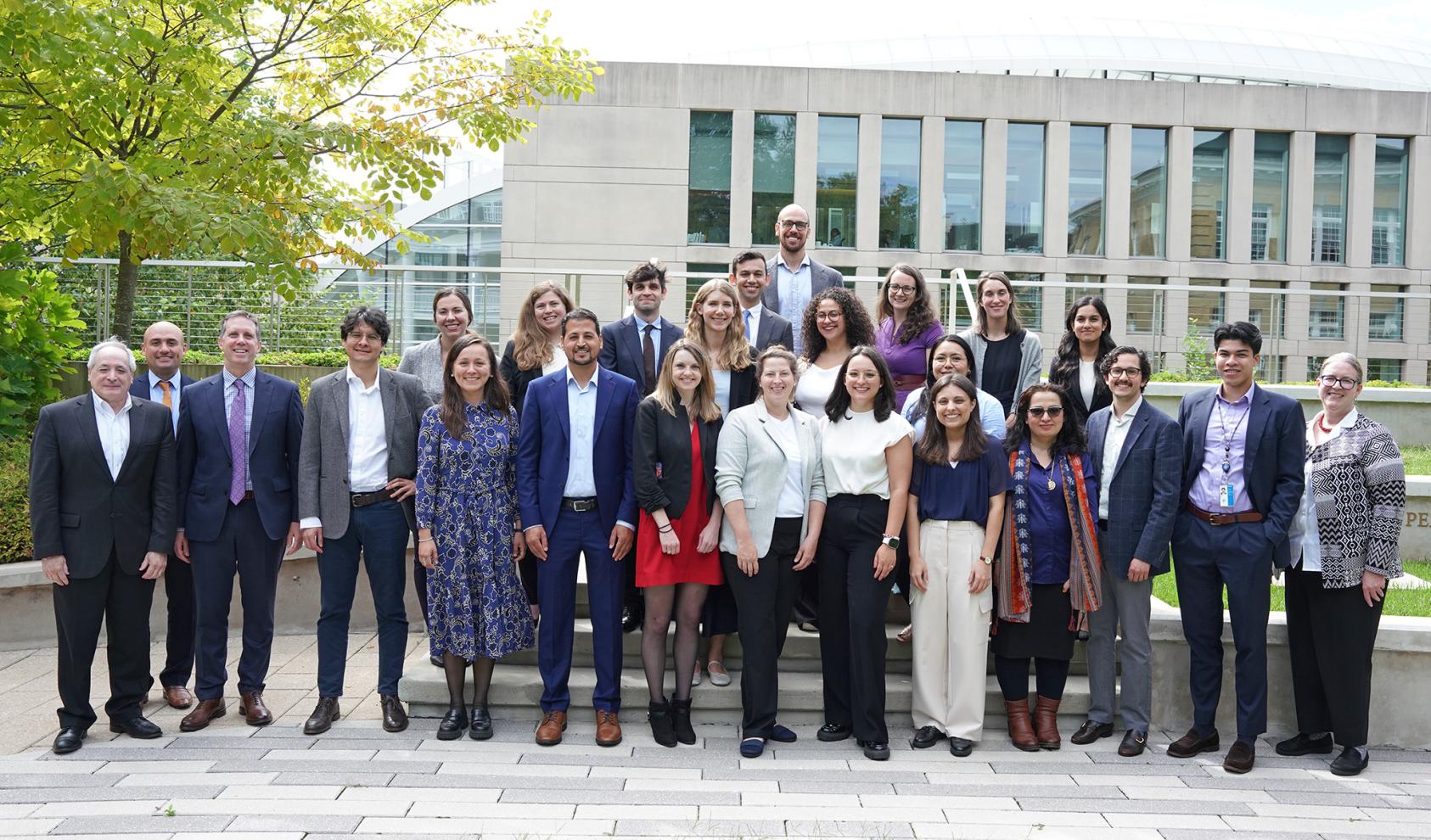
Photo Caption: Current Peace Scholars and Senior Fellows are welcomed to USIP by President Jim Marshall, Academy Provost Pamela Aall, and JR Program Officer Lili Cole.

Current Peace Scholars

Jennings Randolph Senior Fellowships are awarded to a variety of expert academics and practitioners each year to promote cutting-edge research in international peace and security. This year we are pleased to have four Senior Fellows with us who will be researching specific topics within international peace and security. To learn more, read their biographies below:

Jennings Randolph Peace Scholar Dissertation Fellowships are awarded to outstanding doctoral students. The fellowships support one year of dissertation research and writing on topics addressing the sources, nature, prevention, and management of international conflict. This year we are pleased to be supporting ten Peace Scholars who are conducting their dissertation research across the globe. To learn more, read their biographies below.

The 2012 - 2013 Peace Scholar Dissertation Fellowship is from October 1, 2012 – August 31, 2013, unless otherwise indicated.


Michelle J. Bellino
Memory in Transition: Historical Consciousness and Civic Attitudes Among Youth in “Postwar” Guatemala
School of Education, Harvard University

Through a range of educational encounters, Guatemalan youth construct the past and its relationship to their lives while orienting themselves as citizens of a “postwar” nation. Building on emergent scholarship that posits history education as a mechanism of transitional justice, this work explores the historical consciousness postwar generation youth construct as they develop as civic actors. Civic attitudes and actions are critical components of democratic culture, linked to USIP’s mandate to promote peacekeeping capacity. The focus on youth perspectives, along with attention to the interaction between formal and informal educational exchanges, distinguishes this study from existing research. This study will culminate in an ethnographic dissertation based on multi-year fieldwork in Guatemala.

Since Michelle Bellino began her doctoral career as a Presidential Fellow at Harvard Graduate School of Education (HGSE), her work has centered on the intersection of historical understanding, human rights consciousness, and civic engagement in the aftermath of intergroup conflict. She has nurtured this multidisciplinary interest as a Teaching Assistant at HGSE and as a Research Consultant for Facing History and Ourselves and DePaul University’s Human Rights Institute. Over the course of her independent research in Guatemala, she has presented and published her work for audiences of educators, historians, and human rights practitioners. Her research has been funded by David Rockefeller Center, Alumni for Social Enterprise, and American Association of University Women. After completing her studies, Bellino hopes to work as a university educator and a human rights practitioner, where she will continue to incite the civic potential of historical understanding.

Publications:

  • Bellino, M.J. (forthcoming). "The memory war in “postwar” Guatemala: Human rights activism in the aftermath of mass conflict." In J.Briggs & B.Terminski (Eds.) Human rights in times of transition.
  • Bellino, M.J. (forthcoming). "Whose past, whose present?: Historical memory among the “postwar” generation in Guatemala." In Williams, J.H. (Re)building memory: School textbooks, identity, and the pedagogies and politics of imagining community, Vol. 3 Textbooks and conflict.
  • Bellino, M.J. & Selman, R.L. (2012). "The intersection of historical understanding and ethical reflection during early adolescence: A place where time is squared." In M. Carretero, M. Asensio, & M. Rodríguez-Moneo (Eds.) History education and the construction of national identities. Information Age Publishing.


Yelena Biberman
Gambling with Violence? Why States Outsource the Use of Force to Domestic Non-State Actors
Department of Political Science, Brown University

Yelena Biberman’s dissertation research addresses the following questions: Why do states outsource violence to domestic non-state actors? What explains the variation in the types of domestic non-state actors states use in violent conflict? The existing approaches suggest that the persistence of violent non-state actors is a product of either state weakness or failed counter-terrorism strategies. Biberman shows that states can, and often do, play an active role in the creation, radicalization, and ensuing behavior of these actors as part of a wider security strategy. Her dissertation builds and tests a theory of state incorporation of domestic non-state actors into the state’s coercive apparatus. She applies a controlled-comparative case study of the variation in Pakistan’s and India’s use of violent non-state actors in South Asia. To investigate her research questions, Biberman uses semi-structured interviews, archival materials, declassified documents, memoirs, and media reports.

Yelena Biberman is a Doctoral Candidate in Political Science at Brown University. She earned an MA from Brown in 2010, an MA from Harvard University in 2006, and a BA magna cum laude with honors in International Relations from Wellesley College. She has worked as a Journalist in Moscow, a Research Assistant at Harvard, a Teaching Assistant at Brown, and Founder and Director of a national youth enrichment program. Her previous awards include a Fulbright Scholarship, Horowitz Foundation Grant, FLAS Award to study intensive Urdu, IREX U.S. Embassy Policy Specialist Grant, as well as international and national public service awards. For her long-term career, Biberman plans to serve as an academic and policy consultant, focusing on state-supported violence, armed non-state actors, and political extremism.

Publications:

  • "The Politics of Diplomatic Service Reform in Post-Soviet Russia," in Political Science Quarterly, Vol. 126, No. 4 (Winter 2011).
  • "Bureaucratic Partisanship and State Building: The Case of Ukrainian Foreign Ministry," in Problems of Post-Communism, Vol. 58, No. 2 (March/April 2011): 17-27. (awarded the 2011 Millar Prize).
  • "Generation Putin," Foreign Policy, January 22, 2008; available at: http://www.foreignpolicy.com/story/cms.php?story_id=4141


Daniel Blocq
Formation of Armed Self-Defense Groups
Department of Sociology, University of Wisconsin-Madison

During many contemporary civil wars, insurgents use indiscriminate violence against civilians in local villages. In response, some villages organize armed self-defense groups. Armed self-defense groups are armed groups organized from within the village to protect the village against the threat of insurgent violence. In his dissertation, Daniel Blocq investigates variation in the formation of armed self-defense groups. Concentrating on the second civil war in Southern Sudan (1983-2005), Daniel asks why armed self-defense groups emerge in some tribal areas but not in others. Based on eleven months of fieldwork, which included in-depth interviews with tribal leaders, past insurgents, and army commanders across twenty four tribal areas in Southern Sudan, Daniel finds that armed self-defense groups only emerged when village members interpreted insurgent violence in local terms, i.e. when tribal leaders perceived insurgent violence as violence from the neighboring tribe. When tribal leaders did not interpret insurgent violence in local terms, armed self-defense groups did not emerge.

Daniel Blocq is a PhD Candidate in the Department of Sociology at the University of Wisconsin-Madison (2008-present). He received law degrees from the University of Amsterdam and Cornell Law School (1996-2002). He worked as a lecturer in international law at the Netherlands Naval College (2002-2004) and the Netherlands Defense Academy (2006-2007). He served as a UN Military Observer in South Sudan in 2007-2008. Daniel’s research has been supported by the Social Science Research Council, the National Science Foundation, and the Harry Frank Guggenheim Foundation.

Publications:

  • Blocq, Daniel, Bert Klandermans, and Jacquelien van Stekelenburg. 2012. "Political Embeddedness and the Management of Emotions." Mobilization: An International Journal 17(3): 489-506.
  • Blocq, Daniel. 2010. "Western Soldiers and the Protection of Local Civilians in UN Peacekeeping Operations: Is a Nationalist Orientation in the Armed Forces Hindering Our Preparedness to Fight?" Armed Forces and Society 36(2): 290-309.
  • Blocq, Daniel. 2006. "The Fog of UN Peacekeeping: Ethical Issues Regarding the Use of Force to Protect Civilians in UN Operations." Journal of Military Ethics 5(3): 201-213.


Michael Broache
International Criminal Court Interventions in Ongoing Conflict
Department of Political Science, Columbia University

Michael Broache’s research examines the impact of International Criminal Court (ICC) prosecutions initiated during ongoing conflict on compliance with international humanitarian law, specifically violence against civilians. Although both sides in the “peace and justice” debate concerning the impact of prosecutions during conflict have made strong theoretical claims, there has been little systematic empirical research on this topic. This project employs cross-case quantitative analysis and qualitative process tracing to examine how prosecutions affect belligerents’ incentives for compliance. For the process tracing portion of his research, he will conduct semi-structured interviews with government officials and ex-combatants in Uganda and the Democratic Republic of Congo, two countries where the ICC has initiated prosecutions during conflict.

Michael Broache is currently a PhD Candidate in Political Science at Columbia University. He received an MPhil in International Relations from the University of Cambridge in 2008, and earned his undergraduate degree summa cum laude from Princeton University's Woodrow Wilson School in 2006. He previously worked for the International Rescue Committee in Tanzania as a Princeton in Africa Fellow. He has presented papers at the annual meetings of the American Political Science Association and the International Studies Association-Northeast and South. After completing his dissertation, Broache plans to pursue a career as a scholar-practitioner, combing work in academia and government service on transitional justice and conflict resolution issues.

Publications and Presentations:

  • "Rethinking Russian Energy Power," in Journal of International Affairs (Spring 2010), review of Jeronim Petrovic, Robert W. Orttung, and Andreas Wagner, Russian Energy Power and Foreign Relations (New York: Routledge, 2009)
  • "The ICC and Violence against Civilians in Uganda," Southern Political Science Association, January 12-14, 2012; New Orleans, LA
  • "Peace and Justice in Darfur," International Studies Association—South, October 14-15, 2011; Burlington, NC


Steven Brooke
The Retreat of the State and the Rise of Alternative Health Organizations in Egypt
Department of Government, University of Texas

Steven Brooke's dissertation project considers the decline of state-provided health services in Egypt and the rise of private and charity health service providers, including religious and civil organizations as well as political parties. This project is one of the only empirical studies of these facilities in Egypt, and the first to theorize, specify, and test their sociopolitical effects.  Brooke's dissertation project will test a series of extant hypothesizes about these services, including hospitals, clinics, and periodic “medical caravans.” One hypothesis is that these facilities serve as powerful tools for mobilizing voters.  Other existing hypotheses suggest that these services are manifestations of charitable impulses from either religious or sociocultural sources; are part of a larger civil society effort to undermine existing state institutions; or are used primarily to entice recruits or enforce group cohesion. Brooke will deploy a multi-method research design to assess these hypotheses, relying on semi-structured interviews, site visits, GIS mapping, archival research, and an innovative nationwide survey experiment of Egyptians.

Steven Brooke is a PhD Candidate in the Government Department at The University of Texas.  He holds an MA in Middle East and African History from George Mason University and an MA in Government from The University of Texas.  He has also studied at the Lebanese-American University in Beirut.  Formerly, Brooke was a Research Associate at The Nixon Center (now the Center for the National Interest).  He has won multiple fellowships, including a UT Fellowship to attend the Institute for Qualitative Methods Workshop in Syracuse, four FLAS Awards for Arabic as well as a State Department Critical Language Scholarship for Arabic study abroad.

Publications:

  • "The Transformation of U.S. Policy Towards Islamist Organizations," in Western Policy Towards Islamism, Lorenzo Vidino, ed., forthcoming in 2013.
  • "The Muslim Brotherhood in the Middle East and Europe: The Evolution of a Relationship," in Transnationalizing Islam: The Muslim Brotherhood in Europe, Roel Meijer, ed., (New York, Columbia University Press, 2012).
  • "The Near and Far Enemy Debate," in Fault Lines in Global Jihad: Organizational, Strategic, and Ideological Fissures, Assaf Moghadam and Brian Fishman, eds., (New York: Routledge Press, 2011).


Julia Choucair Vizoso
The Ties That Bind: Ethnic Exclusion in Authoritarian Regimes
Department of Political Science, Yale University

Julia Choucair Vizoso’s dissertation examines patterns of ethnic exclusion in authoritarian regimes, with a specific focus on the composition of ruling coalitions. Why do some authoritarian ruling coalitions exhibit cross-ethnic alliances whereas others dramatically narrow the basis of inclusion to coethnics? The project systematically theorizes the use of ethnicity as a response to the challenges of autocratic power sharing and control. By focusing on ethnic exclusion as an outcome, the project contributes to a better conceptualization of a phenomenon to which we attribute crucial developments, particularly ethnic violence.

The research employs a multi-method approach combining cross-national statistical analysis, paired case comparisons in the Middle East and Africa, and in-depth, within-case analysis of Iraq through archival research and semi-structured interviews.

Choucair Vizoso is a PhD Candidate in Political Science at Yale University. She studies authoritarian politics and the mobilization of ideologies and identities. She is a scholar of the Middle East and previously served as Editor-In-Chief of Sada, an online journal on Arab transitions published by the Carnegie Endowment for International Peace. She holds an MA in Arab Studies and a BS in Foreign Service from Georgetown University. She anticipates completing her dissertation in May 2014 and pursuing a career in academia.

Publications:

  • "Correlates of Conflict in the Middle East & North Africa." With Nicholas Sambanis. World Development Report 2011. World Bank (2010).
  • "How serious is the EU about supporting democracy and human rights in Lebanon?" European Council on Foreign Relations (2008).
  • "Beyond the Façade: Political Reform in the Arab World." Co-editor. Carnegie Endowment for International Peace (2008)


Brett Carter
Inside Autocracy

Department of Government, Harvard University

Autocrats preside over 40% of the world's governments; they often consolidate personal authority in the wake of violence and their citizens suffer lower standards of living and more civil war. Despite the harmful consequences for citizens in autocracies, social scientists know relatively little about how aspiring autocrats manage to subvert nominally democratic institutions and consolidate their authority. By going "inside autocracy" in the Republic of Congo, my dissertation argues that aspiring autocrats consolidate power by employing a variety of recruitment and monitoring strategies, conditioned by inherited political institutions, designed to prevent elite coordination. The empirical centerpiece of the dissertation is a pair of original datasets, drawn from archival research and key informant interviews in Congo and Paris. The first dataset records biographic, social, and professional data for 1,300 party leaders, appointees, senior military officers, and legislators since 1970. The second records biographic and professional data for 12,000 members of the security apparatus since 2005.

Brett Carter is a Doctoral Candidate at Harvard University's Department of Government, a Samuels Family Research Fellow at the Weatherhead Center for International Affairs, and a Graduate Associate at the Institute for Quantitative Social Science. He holds MAs from the University of Chicago and Harvard University, and earned his BA from the Virginia Military Institute. His research has been supported by the National Science Foundation, Social Science Research Council, Smith Richardson Foundation, and Harvard. He recently served as a Country Expert for the World Bank and Bertelsmann Stiftung. Prior to graduate school, he was a Fulbright Scholar in Senegal, taught at the University of Malawi, worked for a humanitarian NGO in northern Ethiopia, and consulted for USAID in Mali and Congo (Kinshasa). At Harvard, he serves as the Teaching Fellow for the Political Economy of Africa course, for which he received the Award for Teaching Excellence. After completing his dissertation, Carter will be pursuing a career in research and teaching.

Publications:

  • "Public Policy, Price Shocks, and Conflict: Price Shocks and Civil War in Developing Countries." (With Robert H. Bates), Weatherhead Center for International Affairs Working Paper Series.


Emma Hayward
Legal Pluralism and Group Rights: States and the Devolution of Judicial Power
Department of Political Science, University of Pennsylvania

How can states manage their ties with ethnic and religious minority groups to avoid conflict or insurgency? In her dissertation, Emma Hayward examines a type of power-sharing accommodation between states and minority groups that also has implications for the rule of law: the devolution of judicial power, i.e. allowing groups to have their own courts and legal systems. Preliminary study suggests that this strategy decreases conflict between minority groups and the state, but there has been no systematic study of why states adopt these policies. She has created a new typology of six types of legal pluralism policy, and she examines one case of each. She uses interviews, archival records, and court observation sessions to build a theory that explains how states decide what degree of recognition to accord minority group courts, as well as the efficacy of such arrangements. Hayward will focus her USIP fieldwork on three cases: Lebanon, Tanzania, and Malawi, and her larger project includes Egypt, France, and the United Kingdom.

Emma Hayward is a Doctoral Candidate in the Department of Political Science at the University of Pennsylvania. She received her BA magna cum laude, Phi Beta Kappa from Princeton University’s Department of Near Eastern Studies in 2006 and spent the following year on a Fulbright in Morocco. She has worked as a Teaching Assistant at Penn and a Research Assistant for the Washington Institute for Near East Policy. She also has experience as Director of the Living Cultures Program in Riepe College House, an undergraduate student mentor, and as a founder and coordinator of the Graduate Comparative Politics Workshop. She has won numerous awards, such as a year-long Foreign Language and Area Studies Fellowship, a State Department Critical Language Scholarship, and the Pew Presidential Prize, among others. Her publications include an anthology of Arabic poetry for which she was the sole translator, and policy pieces on North African politics. After completing her dissertation, Hayward intends to pursue a career in academia.

Publications:


Milli Lake
Politics of Punishment: Re-evaluating Politics, Power and the State in Judicial Responses to Gender Violence in South Africa and Democratic Republic of Congo
Department of Political Science, University of Washington

Milli Lake’s dissertation examines judicial responses to gender violence in eastern Congo and South Africa. In recent years, both countries have attracted considerable international attention for their high levels of sexual and gender-based violence (SGBV). In DR Congo, despite seemingly insurmountable obstacles facing the judicial system, domestic courts have produced frequent, sometimes groundbreaking, jurisprudence on this issue. Ironically, in South Africa, a country with a judicial infrastructure and legislative framework far more developed than that of DR Congo’s, the issue has failed to be taken seriously by law enforcement mechanisms: fewer than 5% of SGBV cases are reported to the police and, where cases are brought, convictions are extremely rare. Lake’s research seeks to explain the causes and consequences of criminal accountability. For each case, she suggests that local politics have strongly influenced the treatment of cases by the courts. Lake’s research will elucidate the potential impact of rape prosecutions for long-term peace and stability as well as why international funding and human rights advocacy is effective in some cases and not in others. She plans to analyze judicial decisions, observe rape trials, and interview relevant stakeholders in each site to this end. She will also create a database of military prosecutions processed since 2005 in eastern Congo where little is known about the trials despite a great deal of international funding.

Milli Lake is a PhD Candidate in Political Science at the University of Washington and is a Jennings Randolph Peace Scholar (2012-13) at the United States Institute of Peace. Lake is writing her dissertation on the determinants of legal accountability for gender-based violence in weak states, focusing on the roles of local politics and international development assistance. She is currently living in Goma, DR Congo, which serves as the primary case for her dissertation research. Lake is a Comparative Law and Society Studies (CLASS) Fellow at the University of Washington and an affiliated researcher with the International Law and Policy Institute (ILPI) in Oslo. In the past, she has worked as a Research Assistant for the University of Washington's Voices from the Rwanda Tribunal Project, as a Researcher for the World Bank's World Development Report, and as a Program Assistant for the International Bar Association's Human Rights Institute. Lake received her BA and MA in African History from the University of Edinburgh in 2005.

Publications:

  • "Improving Working Conditions and Rights" (2012). Briefing Paper for the 2013 World Development Report on Jobs, World Bank, (with Margaret Levi and Anne Greenleaf).
  • "Investigating a new design approach in Rwanda" (2011). Proceedings of iConference. New York: ACM Press, 591-597. With Nathan, L.P., Grey, N.C., Nilsen, T., Utter, E., Utter, R.F., Ring, M., Kahn, Z., and Friedman, B.
  • "Multi-lifespan information system design in post-conflict societies: An evolving project in Rwanda" (2010). Extended Abstracts of CHI. 2010 Conference on Human Factors in Computing Systems, 2833-2842. New York: ACM Press. With Friedman, B., Nathan, L.P., Grey, N.C., Nilsen, T., Utter, E., Utter, R.F., Ring, M., and Kahn, Z.
  • Website: http://students.washington.edu/milli/


Michael Weintraub
Rebel Alliances and Competition in Civil War
Department of Government, Georgetown University

Why do armed non-state actors in some multiparty civil wars cooperate with one another, yet in others groups fight on their own or engage in inter-group conflict? What explains temporal and geographic variation in cooperation and competition at the sub-national level? What consequences do these patterns of cooperation and competition have for civilians?

This project makes multiple contributions to the literature on civil war, insurgency, and terrorism. First, it provides a novel explanation for cross-national variation in rebel cooperation. Second, using sub-national data from Colombia, it demonstrates that the politics of credit-claiming within cooperative rebel arrangements reconfigures the deployment of violence by armed non-state actors, offering an unexplored driver of strategic violence in irregular war. Third, based on fieldwork in Colombia, this research provides the first study of sub-national variation in cooperation and conflict among armed actors in the world’s oldest insurgency. Fourth, the project features the only study of the consequences of rebel alliances. Weintraub’s dissertation presents policy recommendations to mitigate rebel violence against civilians and a framework to diagnose what rebel alliances and non-state actor competition mean for peace negotiations.

Michael Weintraub is a PhD Candidate at Georgetown University, currently conducting fieldwork in Colombia. Beyond rebel group behavior and political violence, he has forthcoming publications and working papers on institutional design for divided societies, ethnicity and patronage politics, and political psychology.

Publications:

  • "Altruism, Righteousness and Myopia," with T. Clark Durant. Critical Review 23, 3. 2011.
  • "From Patron-Client Mobilization to Constitutionally Constrained Competition," with T. Clark Durant. Revise and Resubmit.

Selected Working Papers:

  • "How to Make Democracy Self-Enforcing after Civil War," with T. Clark Durant. Under Review.
  • "Learning How (Not) to Fire a Gun: Combatant Training and Civilian Killings," with Benjamin A. Oppenheim and Juan Vargas. Under Review.