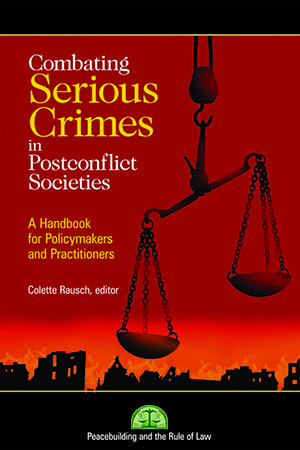
The Serious Crimes handbook is a reference tool for policymakers and practitioners who are designing strategies for tackling serious crimes in postconflict environments.
Published in 2006, Combating Serious Crimes in Postconflict Societies: A Handbook for Policymakers and Practitioners, is the product of two years of meetings and expert consultations with over 40 experts with firsthand experience in combating serious crimes in postconflict environments.
The aim of the handbook is to provide a practical tool to brief individuals on, and to synopsize, the key issues in appraising and approaching the significant challenge of serious crimes. The handbook contains an overview of potential strategies and tools that may be employed in a society seeking to combat serious crimes. In addition, the book contains an overview of these strategies, discussion of the pros and cons of certain solutions, and references to additional materials and resources related to serious crimes.
It is important to remember that the handbook is not intended as a comprehensive treatise on measures to combat serious crimes or as an operational and tactical manual for law enforcement personnel investigating serious crimes.
An important component of the handbook is the inclusion of practical examples from countries dealing with special crimes. To aid in the development of serious crimes strategies, numerous real-life examples from previous and current postconflict societies and other countries that are dealing with serious crimes challenges are integrated into the handbook, including experiences from Afghanistan, Bosnia, Haiti, Cambodia, Kosovo, Liberia, Sierra Leone, Iraq, and other countries.
Click here to download or purchase the book. The handbook is also available in Nepali and Dari.
The views expressed in this publication are those of the author(s).